In my opinion, venture studios stand somewhere between an incubator and a venture capital firm, saving the time and cost that go into idea validation and setting up the base infrastructure with a custom-made stack (which their incubated companies can use from day one).
While in a normal sector, a wrong idea costs a few months of effort in code, in healthcare, it costs a clinic, doctor contracts, and trust that takes months to compound. So 2070 does the idea search in-house before the founder even joins.
How it works
W Health is the fund. Its Fund I backed existing companies like BeatO, Wysa and BabyMD. The ₹700 Cr Fund II is earmarked for 8–10 companies, focussing on single-specialty care (exploring longevity, geriatrics and chronic pain) and AI-enabled B2B services across the US and India.
2070 is the studio. It builds companies in white spaces, such as Everhope (oncology, with Narayana), Nivaan (chronic pain), Elevate Now (weight loss) and Reveal (AI services for US healthcare). The fund finds and the studio builds. Both run the same filter: a clinical problem where care varies wildly and a protocol can narrow the gap.
The flywheel
- Find a gap: Hundreds of ideas are screened for clinical validation, scalability and willingness to pay.
- Test before committing: A team of clinicians and builders experiments first, before building out the team and the platform.
- Launch on a shared platform: About 40 people cover engineering, regulatory, clinical partnerships and talent. The first patient comes in about 53 days (as per podcasts I found online).
- The team runs the clinic and the learnings flow back to the studio.
My two cents The product here is the protocol, not the app. In oncology, pain and paediatrics, the gap between doctors is the problem. Software's job is to make the protocol survive the average doctor in the tenth city.
The idea validation and initial building journey are done more by the studio's network and the brand, while the founder inherits the result when they are immersed in the idea. Does it hold without them? At Favcy Venture Builders I saw that studio-seeded ideas rarely pivot and have a harder fight than a normal startup to prove themselves once they've invested sizeable time building it out. In healthcare this can lead to a lot of sunk cost, so I believe stop rules have to be built in much earlier in the journey.
While most of the information and learning flow is from the studio to the startup, ideally it should also flow back to close the loop, so that one company can learn from the mistakes of its predecessor and the flywheel improves over time.
Outcome data is the compounding asset. Every clinic can double as a data source that tells the next pick what works and gives payers something to pay against. At Visit Health we launched close to a dozen healthcare products ranging from cashless OPD, medicine delivery, diagnostics, vision care, dental care, geriatrics, women's care, physiotherapy, dermatology, minor procedures, reimbursement, annual health checkups, policy underwriting, and more. Each product manager owned multiple such products, with the information being shared each week with the entire product team so that the learnings compound and success in a particular service can be utilised or improved further, or tested out in another.
———
My thesis and areas I'm bullish on
- Personalised, specialised care: Healthcare designed around a person's specific conditions and custom-made according to their health markers. This will only accelerate with the rise of personal agents and the democratisation of compute.
- AI on repetitive, low-judgement work: Workflows around care that have a certain element of repetition or structured care, like notes, scribes, and follow-ups, will get automated. In the US, Epic already ships its own, and I expect Indian EMRs to follow. The value is inside a care model.
- Specialty chains, especially outside the metros: Healthcare is disaggregating and, with PE money moving into the hospital platforms, operators that standardise care will be able to keep margins. A beautiful example is the new outcome-based model for doctors' pay at Even Healthcare.
🟡I played around with Claude, trying to map the Indian healthcare industry, and here is what it gave me.
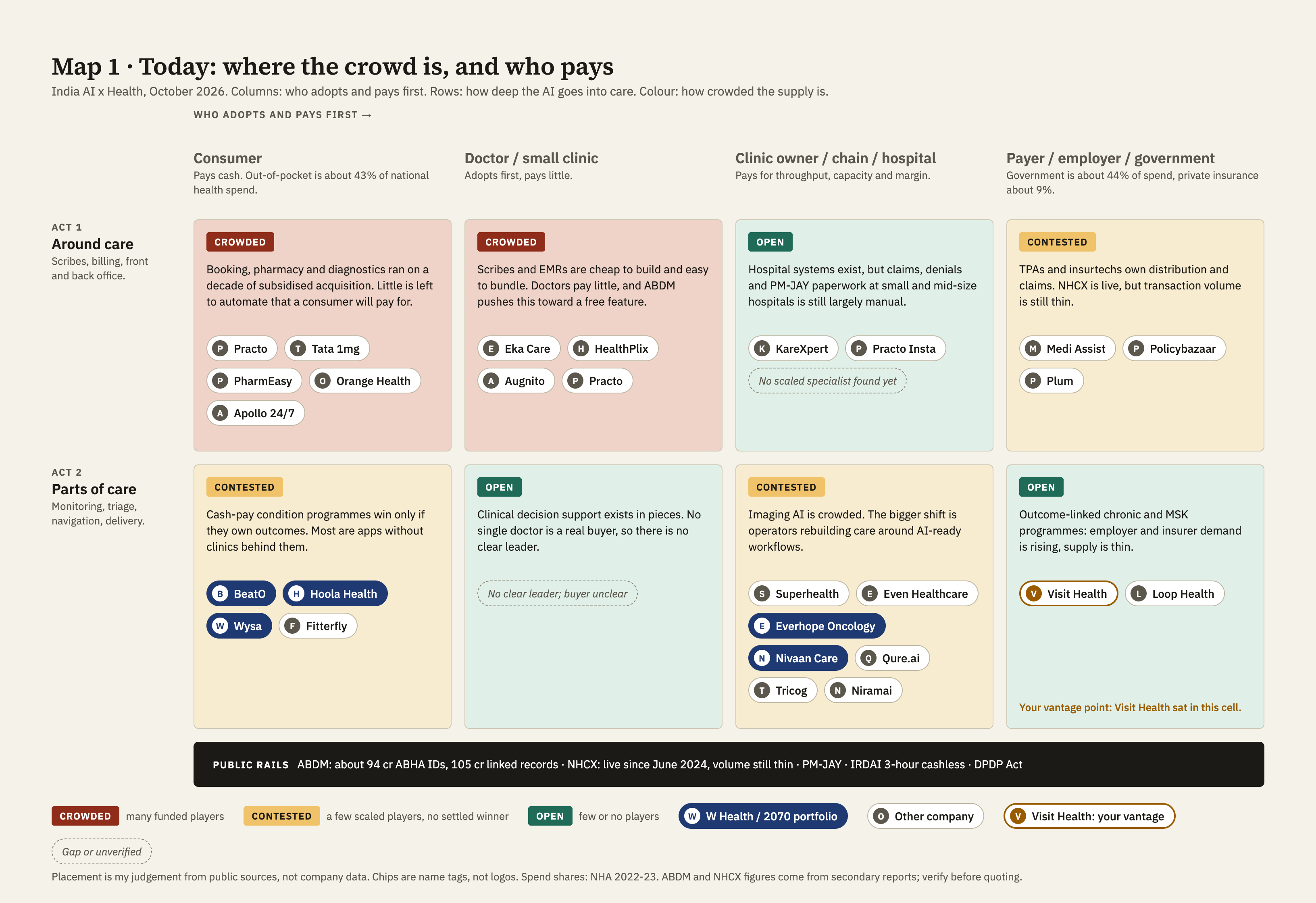 Map 1: today. Columns are who adopts and pays first, rows are how deep AI goes into care, colour is how crowded it is.
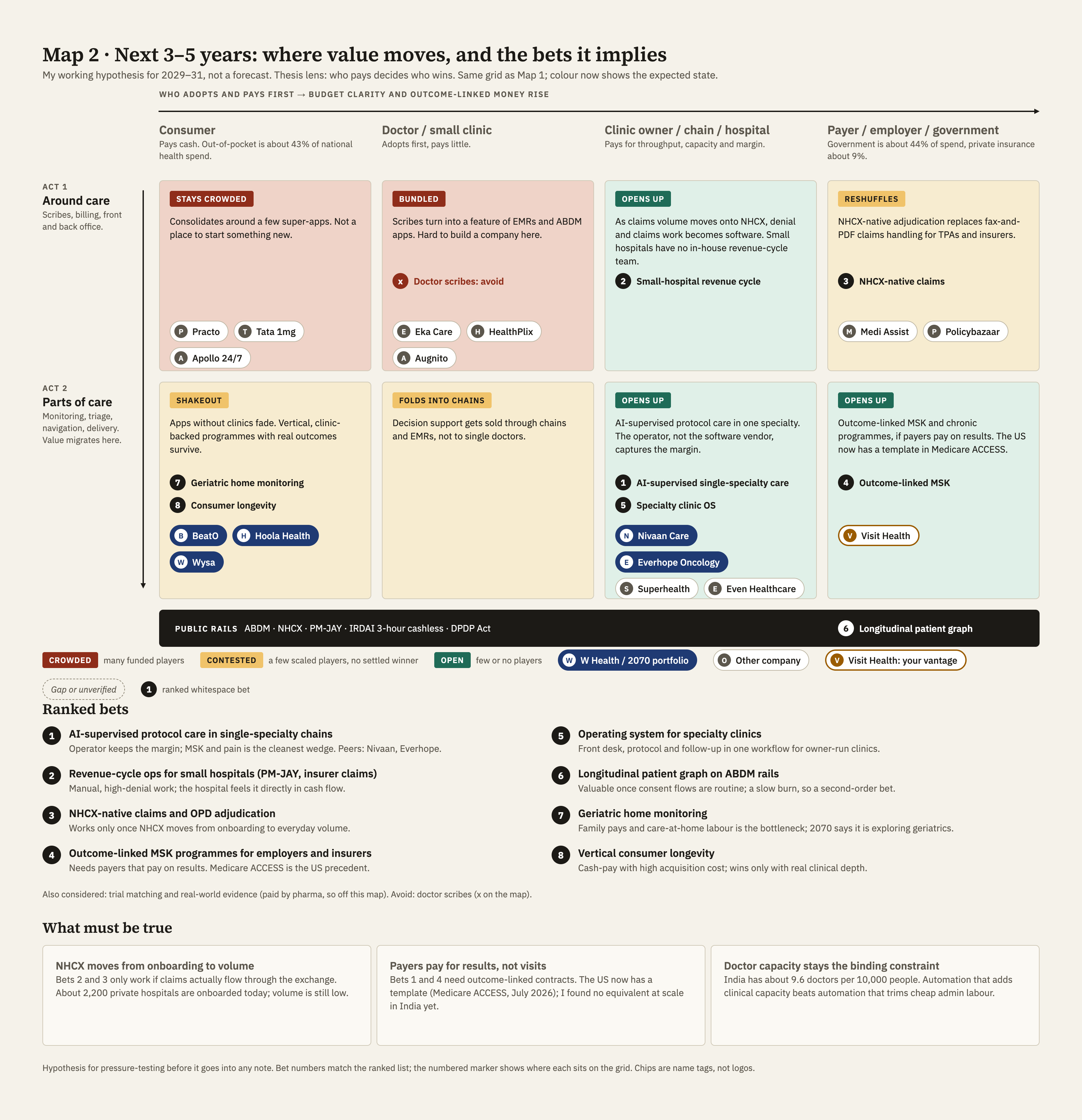 Map 2: the next 3–5 years. Where value moves, and the ranked bets.