Open the live demo ↗ · See the code on GitHub ↗
01What it changes
Most brands on Razorpay will never have a support engineer watching their payments. Resolve does that engineer's first job for all of them, from a two-founder shop to Flipkart.
- Hearing about it. A founder finds out from angry messages days later. With Resolve, the alert reaches their WhatsApp 55 minutes after the bad deploy.
- The root cause. A big brand waits hours for the gateway's engineers to post one in a shared Slack channel. With Resolve, it lands in the brand's own Slack 6 minutes after their alert, with approval buttons in the thread.
- The silent customers. A broken webhook locked out 85 paying customers. 17 complained. Resolve finds the other 68 and wins them back.
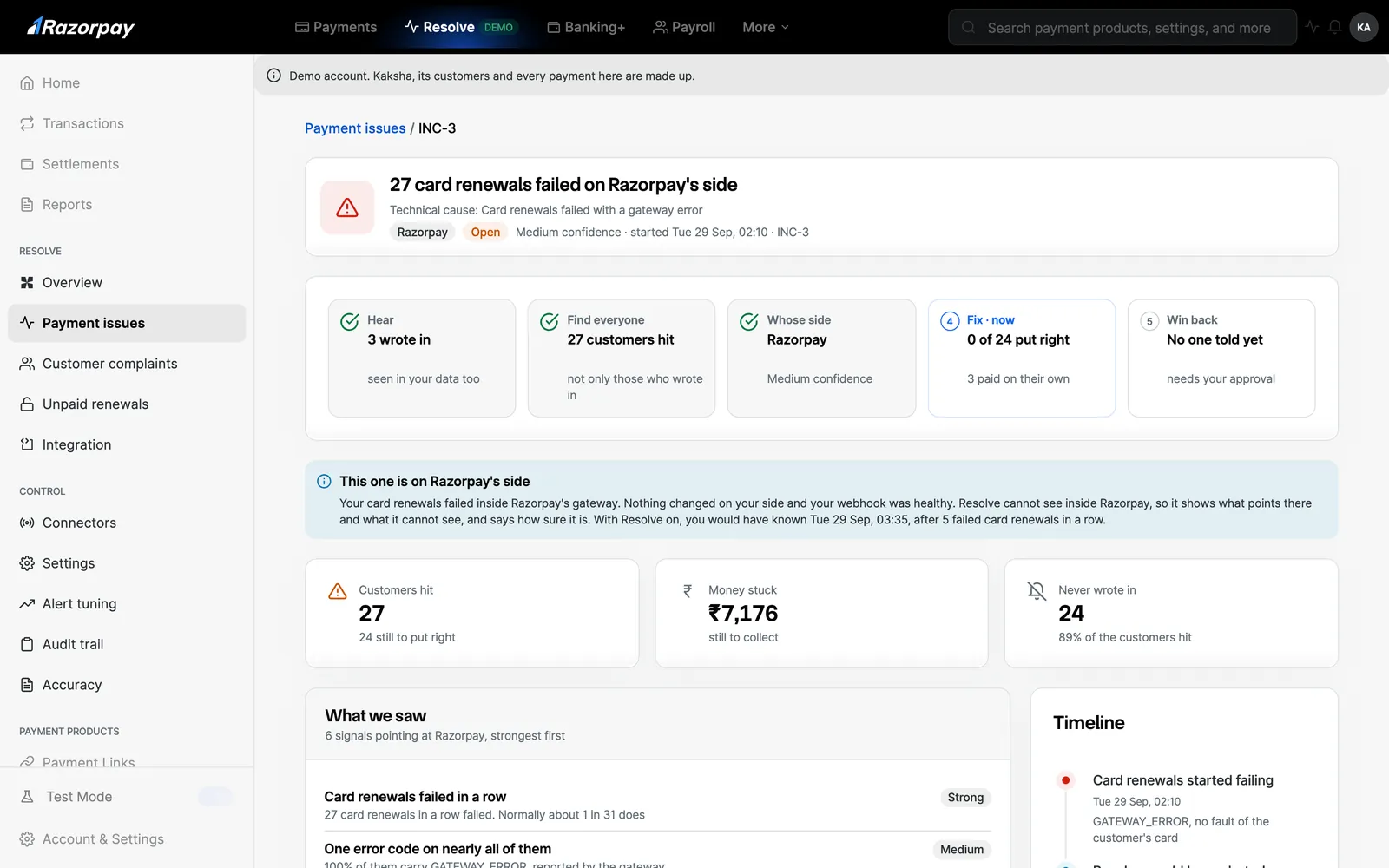
- The blame. Instead of "check your integration", every incident names whose side it is, with proof. When the fault is Razorpay's, Resolve says so and the fix is free.
For Razorpay, every recovered order is volume it processes, and a brand that gets its root cause in minutes has one less reason to move traffic to a second gateway. All figures above come from the demo's made-up scenarios.
02The problem
A payment can break in five places. The pay page doesn't load. The bank declines or times out. The gateway errors. The payment goes through but the brand's system never hears about it, so the customer pays and gets nothing. Or something goes wrong later: a double charge, a refund, a failed renewal.
Razorpay already has strong tools for the middle of that list, the payment in flight. The two ends belong to nobody. There, each side sees half the picture: the brand can't see Razorpay's records, and Razorpay can't see the brand's. Most customers who fail once just leave. As one founder put it on r/startups, "the only reason we even notice is because someone opens a support ticket days later."
I tested part of this myself. In a test account I broke a webhook on purpose. Razorpay retried 15 times over 22.8 hours and stopped. The webhook stayed switched on, no banner appeared, and six failed deliveries left no trace on the webhook screens.
03The bet
Own the edges of the payment. RAY, Vulcan and Payment Links cover the payment in flight, so Resolve takes everything before and after.
Sell recovered revenue. Routing already owns success rate. Resolve's north star is value recovered, counted only after a check confirms it, and net of customers who would have come back anyway.
Name whose side it is. The answer can be the brand's code, the brand's settings, Razorpay, the bank, the customer, or "unknown", which is allowed. Only Razorpay can compare one failure across thousands of merchants and answer "is it just you?", so only Razorpay can build this.
04How it works
Every incident runs the same five steps: hear it, find everyone it hit, say whose side it is with proof, fix it with approval, and win the customers back.
A small brand and a big brand find out about problems in different ways, so Resolve has two front doors and one engine. A small brand hears from customers on WhatsApp, Instagram, email or a help button, and Ray, the assistant, brings the answer to the founder on WhatsApp. A big brand hears from its own alert tools (Sentry, Datadog, PagerDuty), and gets a root cause in its Slack with approval buttons in the thread.
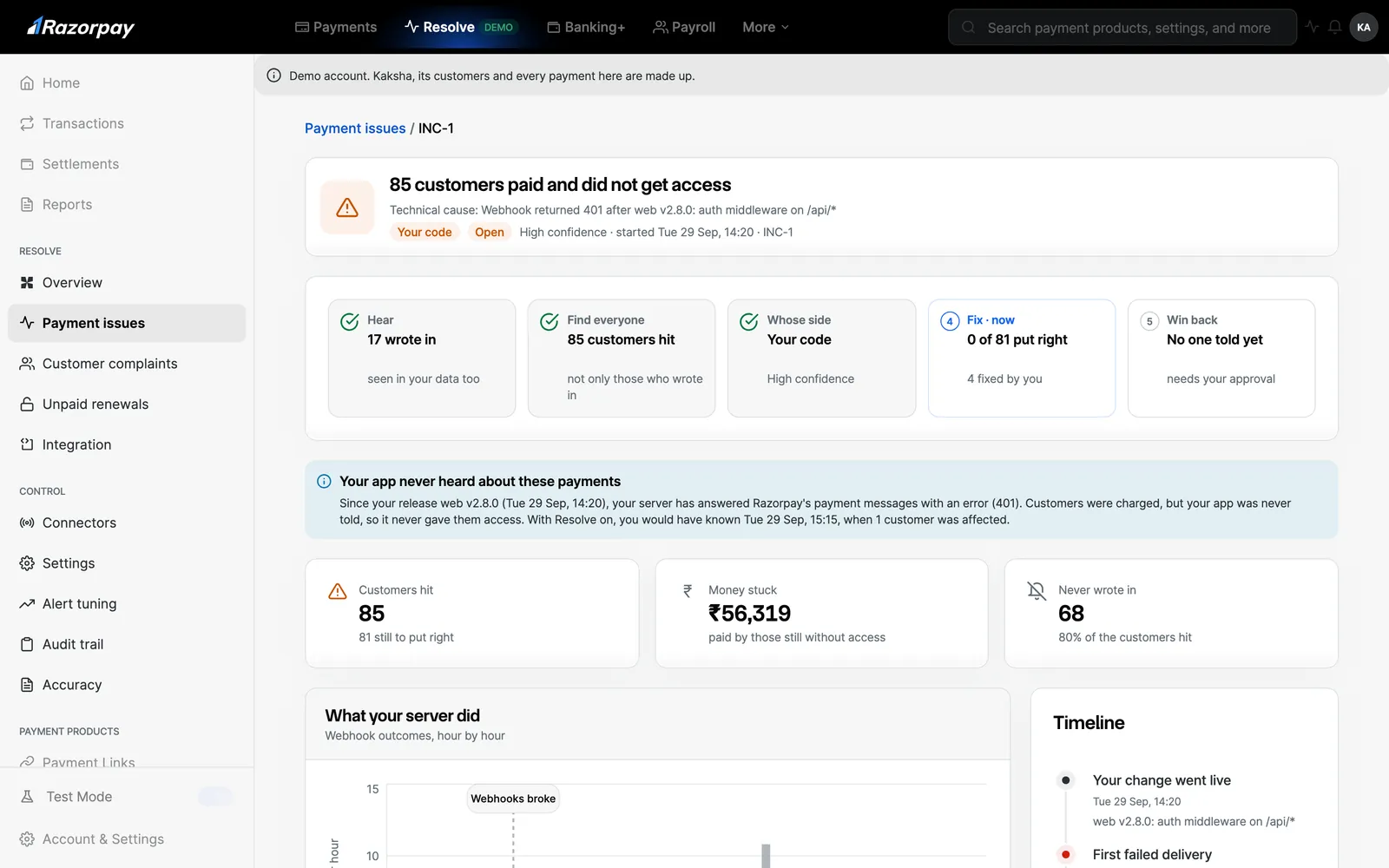
Fixes roll out in stages: a dry run, the first five customers, then everyone else. When the fault is in the brand's code, Resolve writes a page for their developer and never touches the code itself.
05Built to be trusted with money
An agent that refunds money and messages customers earns trust before it earns speed.
- Three levels of autonomy: Review first (the default), Approve once, and Full automation. Some actions stay off at every level: revoking access, refunding to a different method, changing Razorpay settings, writing to the brand's database.
- Refunds go to the original method, one customer at a time, up to ₹5,000 a day, and a person approves each one even on full automation. That costs a founder about 10.5 minutes per incident against a 10-minute target, and the product reports it.
- The assistant says it is an AI and never asks for a card number, OTP, UPI PIN or password. No message uses false urgency.
- Every number on screen comes from SQL or Python, never from a model.
- An issue closes only after 24 healthy hours.
06Decisions I made, and why
No AI model runs in the prototype. A live model step the day before the deadline meant eight hours, a new dependency and no way to test it. So I measured where plain rules break instead. On 41 messy complaints (Hinglish, typos, forwarded text, two problems in one message), rules read the main issue right 85% of the time and caught both problems in a two-problem message 0 times out of 5. That gap is exactly where a model earns its cost in production. It matches the rule Razorpay's own engineers describe: a model reads, ordinary code moves money.
A Flipkart developer read my second version as "it finds integration errors." That undersold it, so I rewrote the problem from first principles and added the big-brand door. A Razorpay PM asked for an at-a-glance view, so the home page became a dashboard in Razorpay's own style.
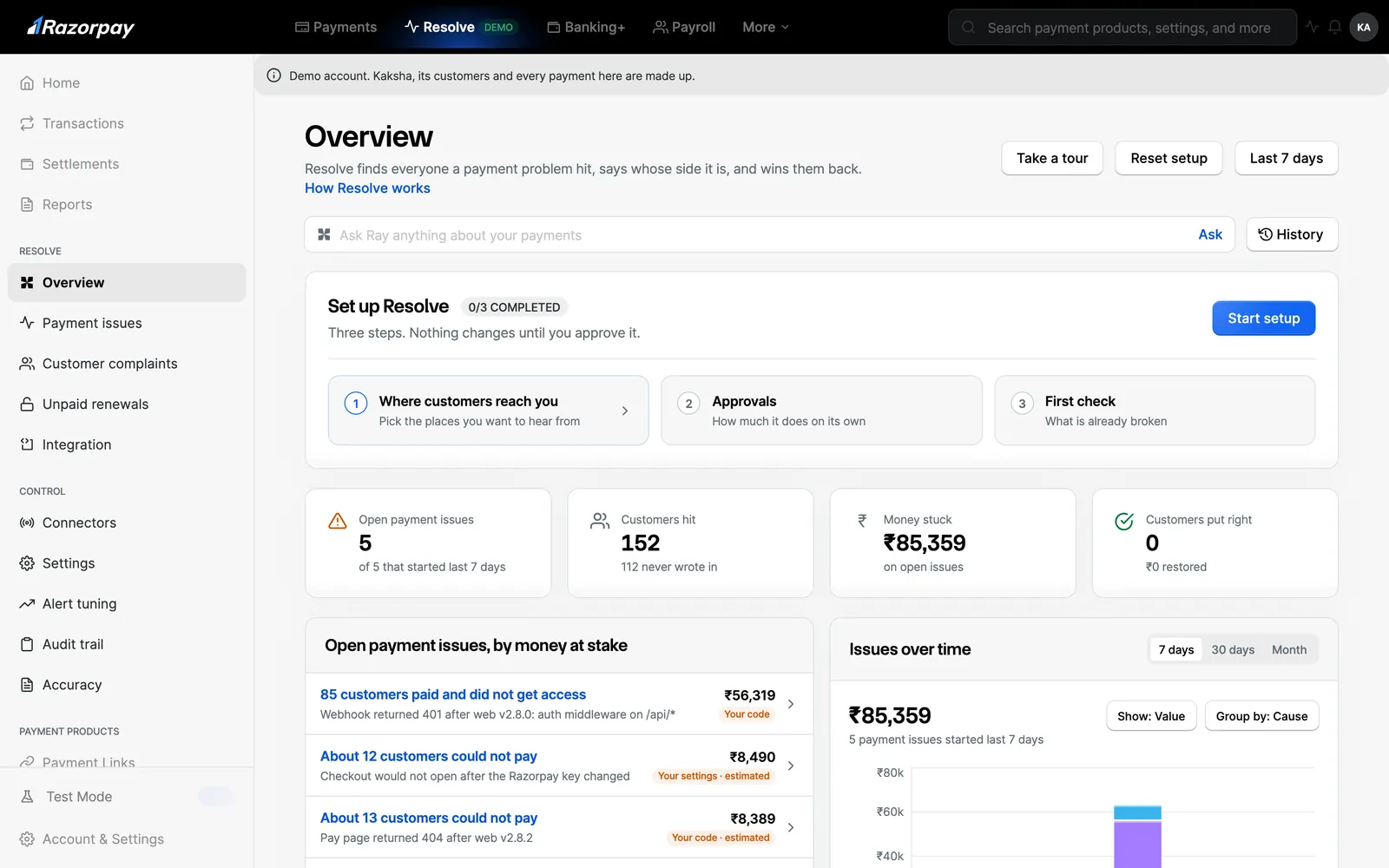
People testing it a day earlier couldn't say what the product was. I renamed every page and rewrote every line in Razorpay's own words, and cut the menu from 12 items to 10.
Connection comes first in production. Razorpay now integrates merchants through a prompt they paste into a coding agent. That prompt can carry the one call Resolve needs, so every new merchant is covered from day one at no effort.
The working name was Blindspot, which named the problem. On the last day I renamed it Resolve, after the outcome a brand pays for.
07The business case
A low-cost bet on merchant trust: about ₹0.86 crore a year to run, with model tokens about 3% of that. Watching is free. A fix costs 1% of the value restored, the first one is free, and it is always free when Razorpay is at fault. Prevention checks are a monthly plan. A six-month pilot with about 200 merchants has six gates, and if two fail, the free watching still stands on its own. The weakest assumption is how many brands pay for prevention.
08Proof
- 170 commits, 48 merged pull requests and about 32,500 lines of Python and TypeScript in nine days. I can't code. Claude Code wrote all of it, one session, branch and pull request per piece of work, and I merged each one after the checks passed.
- 147 checks pass against hidden ground truth and 0 fail. 627 backend tests, and 260 browser tests at phone, tablet and desktop widths.
- I caught the AI's mistakes: it stored card numbers a customer typed in, its "never ask for an OTP" check let 27 of 30 new phrasings through, and it wrote tests that could not fail. Since then I break the code on purpose before I trust a test.
09What is simulated
All Razorpay data, every customer, conversation and channel is made up. The hosted demo replays recorded output from the real engine, and the big-brand flow runs on recorded data. The detection, attribution and fix logic is real, and so is the webhook observation. The made-up world and the detector share assumptions, so 147 passes prove the logic, not its error rate on real traffic. No brand has been asked to pay yet. Not affiliated with Razorpay, and Flipkart appears as a name only.
10What I took from it
- Own the metric nobody owns. Success rate belongs to routing; recovered revenue belonged to no one.
- "Unknown" is a valid answer. A product that admits what it can't see gets trusted with what it can.
- Measure the gap before adding the model. The 0 out of 5 showed exactly where a model pays for itself.