Open the live demo ↗ · See the code on GitHub ↗
01What it changes
- Time to clear. A brand manager gets the deck back from legal on day nine. PRAMAAN's rule checks run in milliseconds while the copy is being written. The target is under 90 seconds for an automated clearance and under 24 hours when a person has to look.
- Legal's time. Mechanical checks are done by code, so lawyers spend their time on judgment. The benchmark it is built against is 40% less reviewer effort, measured at a top-10 pharma company after a year.
- Rule changes. Today a new rule means weeks of digging through live ads. PRAMAAN re-checks the whole portfolio and lists what now breaks, ranked by reach, with a target of under 24 hours to fix.
- Evidence. Every decision is logged, and a pack for the regulator is one click.
- The AI investment. Everything Unilever's AI tools make is worth nothing until it is cleared. PRAMAAN is what makes that capacity shippable.
02The problem
Unilever taught its brand teams to make 400 assets where they used to make 20, across 21 markets, with 300,000 influencers, for social video that lives about four days. It did not teach them to clear those assets. Making capacity went up about seven times. Clearing capacity stayed where it was. An ad earns nothing until it's cleared, so the bottleneck has moved from making to clearing.
The reason is old. Copy is written at the start of the chain by people who don't hold the current rules. The people who hold them, legal and the claims team, sit at the end. The first time an asset meets a rule is in review, which guarantees rounds of changes.
Meanwhile the regulator has automated. In ASCI's report for FY25-26, 98% of the ads it looked at needed changes, 93% were caught by its own AI monitoring, and 97% of influencer ads needed changes. The regulator has an agent. The advertiser doesn't.
03The bet
Unilever's existing system, Brand DNAi, governs what the AI reads. PRAMAAN governs what the world sees. It works like a spell-checker at the moment of writing, so clearance stops being a queue at the end. Compliance is how it works; speed is what it sells. The interface never says compliance. It says Cleared, Needs edit and Blocked.
Two design choices hold it up.
Rule checks and judgment calls are separate code. A banned claim or a missing disclaimer never touches a model, because a model there would be slower, costlier and could answer differently twice. Every verdict shows the time each part took.
A flag without a rule can't exist. Every finding is built through one function that looks the rule up and fails if it's missing. An uncited flag is a build error, so legal can trust every flag it sees.
04How it works
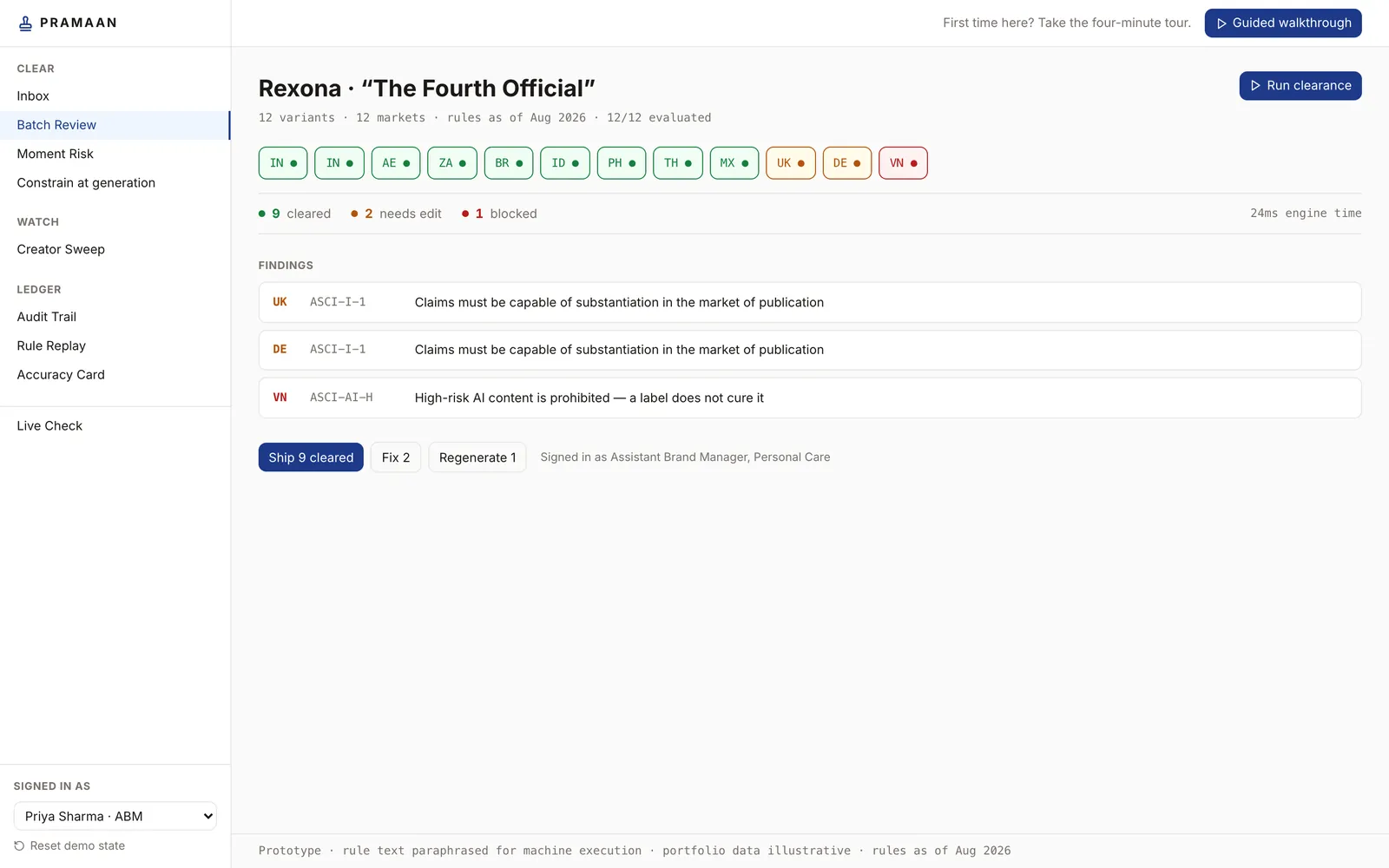
Batch review. Twelve versions of a Rexona campaign resolve in seconds to 9 cleared, 2 needing edits and 1 blocked. The UK and German versions say "clinically proven 72h", a claim backed only in another market's dossier. Apply rewrites the copy and the engine checks it again, so the verdict is earned, not switched.
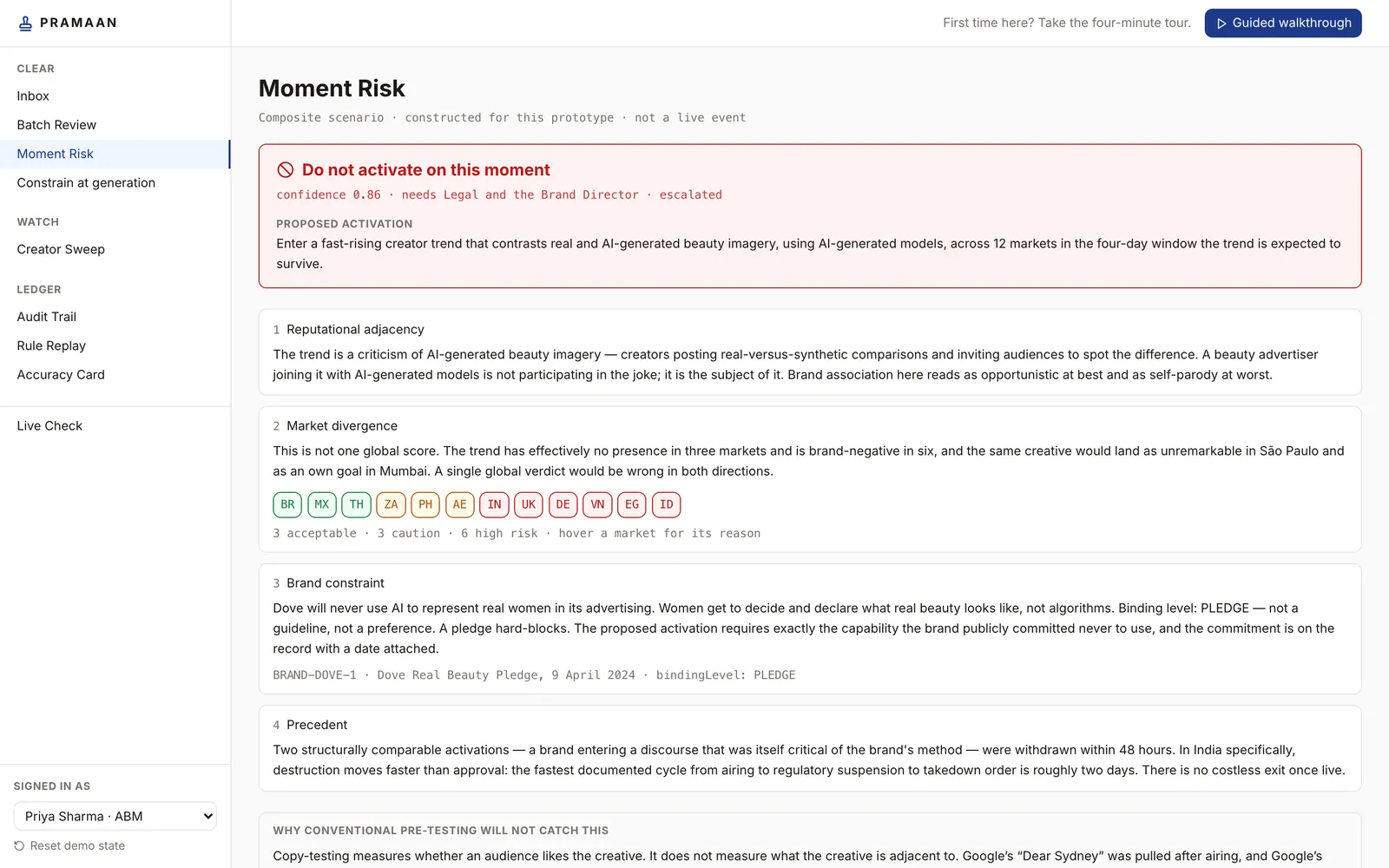
Moment risk. The agent turns down a tempting trend. Four reasoning cards cover the reputational risk, how each market differs, Dove's pledge never to use AI to represent real women, and what happened to brands that tried something similar. A well-reasoned no is the best answer to "won't the AI make things up?"
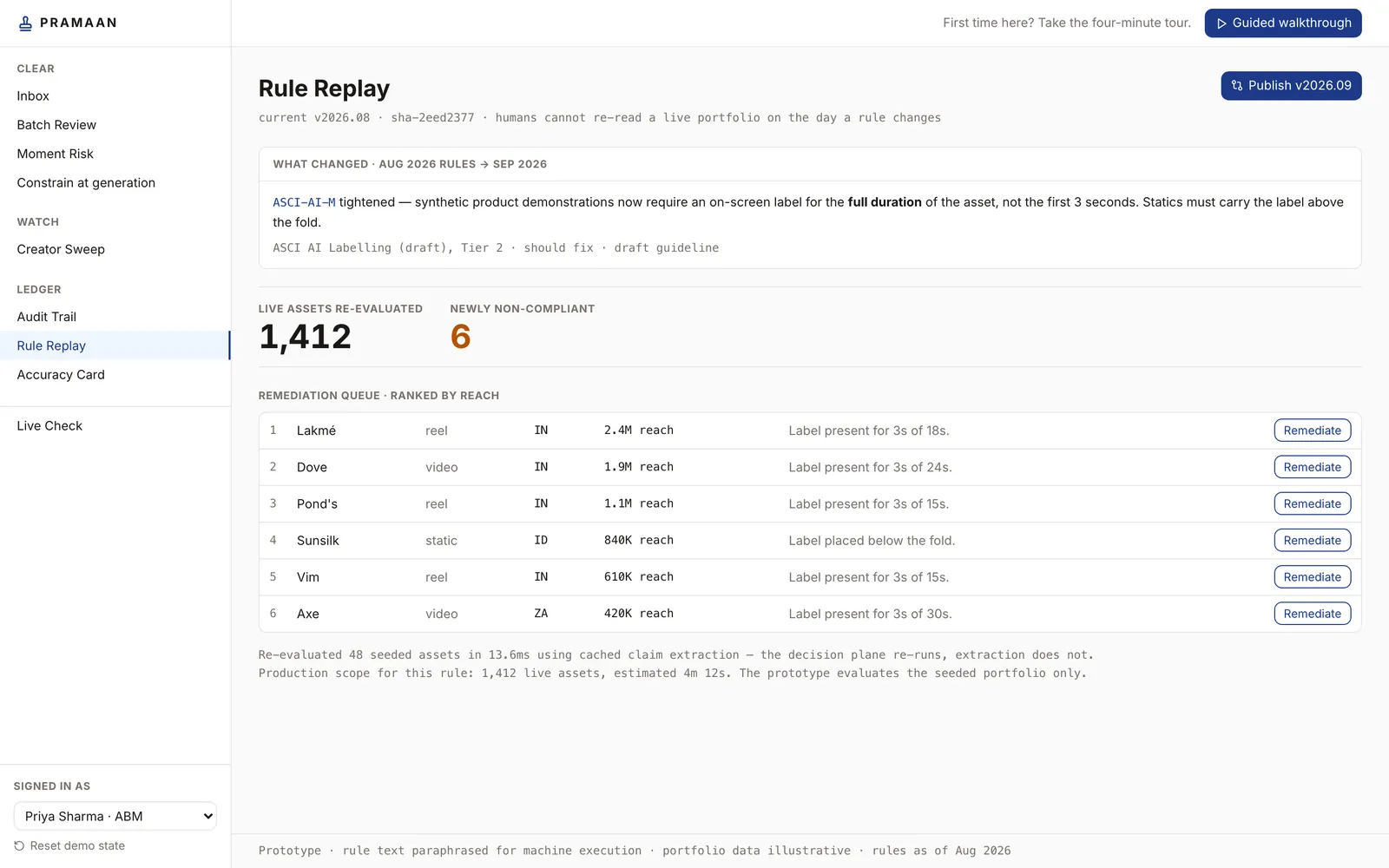
Rule replay. Publish a tightened rule and the engine re-checks the live portfolio, surfacing the six assets that now break it, ranked by reach. No reviewer can re-read thousands of live assets the day a rule changes.
Around those three:
- Live check. Type any copy and see the verdict. It uses Gemini when a key is set and falls back to the rule engine when it isn't.
- Where people write. A Chrome extension checks copy as you type in Gmail and Google Docs, using the same engine.
- Audit trail. It only adds, never edits, and builds a pack for the regulator in one click: the asset, its clearance record, the rule version, the claims dossier and who approved it.
- Clear roles. Legal can override a verdict but can't publish. Legal clears; the brand team ships.
05Decisions I made, and why
I cut three modules (portfolio exposure, precedent search and live web monitoring) using a cut ladder agreed before the build started. The three demos, the AI Studio agent and the slides were never on it.
It will not generate creative, pick influencers, spot trends or replace the asset library. Other Unilever tools do those. It removes unnecessary approvals, never approvers.
I ranked features on a two-by-two of unique versus expected, and built the unique ones first: replay and moment risk, which no human reviewer can do. Every hour spent polishing an expected feature is an hour taken from the ones that set it apart.
No login and no landing page: it opens straight into the inbox. Everything except live check works with wifi off, so a demo can't fail on the venue's network. The moment-risk scenario is a labelled, made-up composite, so the refusal demo isn't built on a real controversy.
06Proof
- Planning started at 4:15 am with an empty repo. The last commit was at 10:19 pm the same day.
- 47 rules, each with a link to its source, 25 approved claims and 60 seeded assets.
- 98 checks across five test suites, including 12 engine checks that guard the numbers the pitch depends on: the 9, 2 and 1 split, the six replay assets, and zero uncited flags across all 60 assets.
- I labelled 30 test cases by hand before measuring accuracy. Writing the labels first exposed three real engine bugs, such as "23,800 strands" slipping past a pattern. After the fixes it scored 1.00 precision and recall on those 30, a set too small to promise more than that.
07What is simulated
Rule text is paraphrased so a machine can run it. It is not quoted law, and a real rule pack would be written by regulatory lawyers. Draft ASCI rules are labelled draft. All data is seeded. Rule replay counts up to 1,412 assets, the real scope for that rule, while re-checking the 48 seeded ones, and the screen states both. Not affiliated with HUL or Unilever.
08What I took from it
- Find where the constraint moved. More AI-made ads don't help if they all wait in the same review queue.
- Keep AI away from the checks a rule can do. Spend the model on judgment.
- Make the guarantee structural. A citation enforced by the code beats a citation checked by a test.