01What it changes
- Speed. Loading a roster takes a commercial plan 15 to 30 days today, and a Medicaid plan 30 to 90. In MedCare, a new phone number or opening hours that pass every check go live the moment the clinic submits. That is how a plan meets a two-business-day legal deadline without hiring more analysts.
- Quality. Errors are caught while the clinic types, each with a fix, so the plan never receives a broken file to clean up.
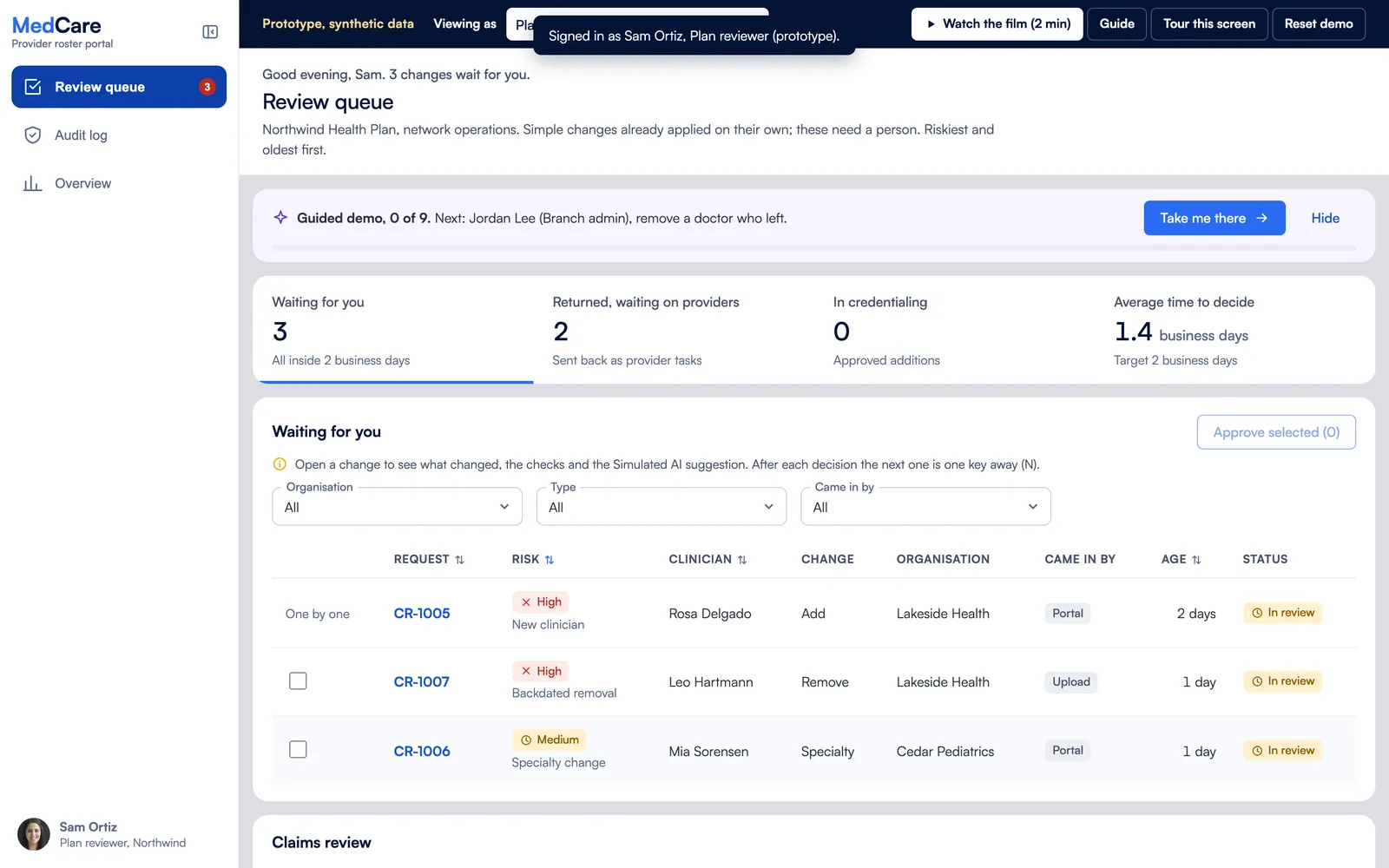
- Reviewer time. Reviewers see only the risky changes, riskiest first, each with its reason. The target is half of all changes applied with no reviewer at all.
- Proof. Every change records who, what, when and through which channel, and nobody can edit it. An auditor can see the roster exactly as it stood on any past date.
- Clinics. They see what the plan has on record, learn why something came back, and answer in a thread instead of on a phone call.
02The problem
In the US, a health plan's directory tells members which doctors they can see. Close to half of those listings are wrong. CMS reviews found 44% of 18,852 locations inaccurate between 2022 and 2024, and a 2025 review by the inspector general found 55% of Medicare Advantage mental health listings inactive. A member calls a doctor who left months ago. People call these ghost networks.
The cause is plumbing. Clinics send their roster to each plan as a spreadsheet, by email or file transfer, in whatever layout they like. One study found five different formats for a provider's last name across ten plans' templates. An analyst at the plan reformats every file by hand and checks it against a national registry that has errors of its own. The clinic can't see what the plan has on record, gets rejections without a reason, and gets chased by phone. Later, nobody can prove what changed or when.
The law has a clock on it. Under the No Surprises Act, providers confirm their data every 90 days and plans must update within two business days.
The case question: should MedCare, a company that sells provider data tools to health plans, build a portal for providers?
03The bet
Yes, if the portal is the plan's tool that providers happen to use. MedCare's buyer is the health plan, and a tool that seems to side with providers would worry the customer who pays. So the portal sits inside the plan's roster workflow: providers do the typing, and the plan keeps the decision.
Five rules shaped everything after that. One pipeline for every channel. Check at entry. Apply safe changes automatically and send the rest to a person. Give something back to everyone who does work. Keep each plan's data apart.
04How it works
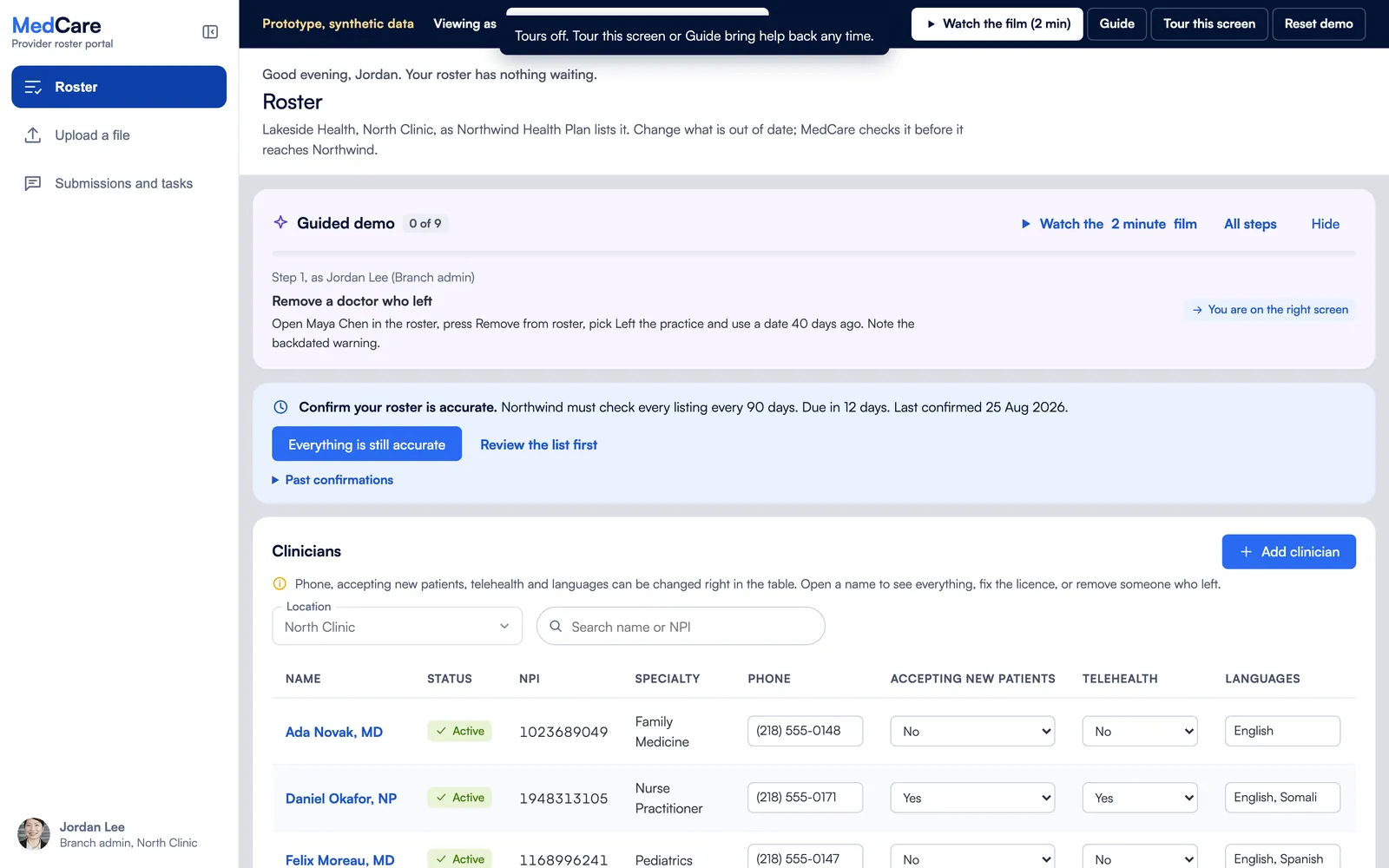
- One change request. A form, a file upload, a file transfer or an email all become the same object: what changed, before and after, the effective date, the reason, the check results, the history and a thread. One shape gives one queue and one audit trail, whatever the channel.
- Checks as the clinic types. Ten checks run at entry: the NPI check digit, required fields, a registry lookup, the licence board and exclusion list, duplicates, removals backdated more than 30 days, and the last specialist at a location. Each failure says how to fix it, and submit stays off until it's fixed.
- Risk decides who looks. A phone number or opening hours with every check passing applies at once. A new doctor, a backdated removal or a specialty change always goes to a reviewer.
- Threads, not calls. A reviewer can return a request with a question, which becomes a task for the clinic. The reply and the attachment go back into the same request.
- Effective dates flow downstream. Approving a backdated removal sends the affected claims for review, and every decision shows the change event that claims, prior authorisation and care coordination would receive.
05Decisions I made, and why
No framework and no build step. The case had a one-hour window. A static folder deploys in seconds and can't break in a build.
No accounts. The brief asked for a link anyone could open. Switching between five logins in one browser shows both sides of every change, which is the whole pitch.
I kept HiLabs' own look and changed only the name, so reviewers from HiLabs would feel at home. One thing I changed on purpose: their dashboard colours an arrow red on a metric that is meeting its goal. Here an arrow is coloured by whether the change is good. Status always has a word and an icon, never colour alone.
No maps, funnels or trend charts where there was no geography or time series to justify them. Loading states only where the app is waiting on something. And a guided demo that tracks which steps you've finished, because evaluators open the link alone.
The next morning I ran a persona pass: five reviewers, one for each login plus an evaluator, each writing down where they got stuck. That turned check codes into plain names (NPI number, State licence), gave reviewers a Next button and keyboard shortcuts, and made attesting a roster with open requests ask first.
06How it would be judged
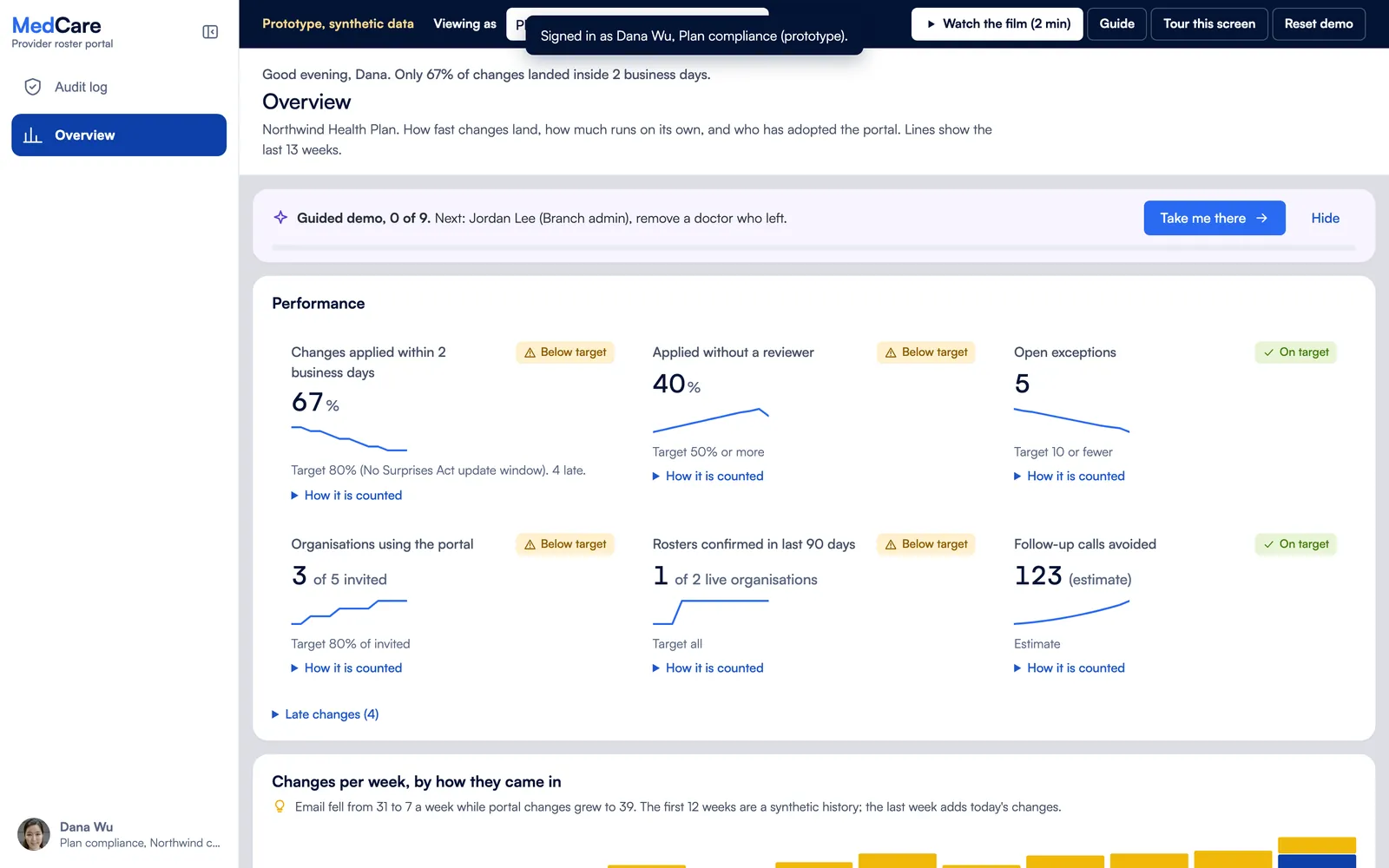
Six measures, each with a target and a "How it is counted" note:
- Changes applied within two business days, target 80%, the No Surprises Act window
- Changes applied without a reviewer, target 50% or more
- Open exceptions, target 10 or fewer
- Organisations using the portal, target 80% of those invited
- Rosters confirmed in the last 90 days, target every live organisation
- Follow-up calls avoided, labelled as an estimate
A weekly chart of changes by channel shows email giving way to the portal.
07Proof
- The case opened at 9:45 pm. The first full build was merged at 10:38 pm, 53 minutes later, and the live site passed its checks by 11:15 pm. The film and the persona pass came the next morning.
- 88 feature checks, a smoke test of every login and screen at four screen widths, and a nine-step demo path.
- Zero axe violations against WCAG 2.2 A and AA on every screen and state, at phone and desktop widths, with full keyboard use.
08What is simulated
Every name, NPI and phone number is invented. The registry, licence board and exclusion list are small fake tables. The AI suggestion a reviewer sees is canned text labelled Simulated AI. State lives in one browser, so two visitors never see each other's changes. MedCare is the fictional company in the case brief, and this is not affiliated with HiLabs.
09What I took from it
- Who pays decides the product's shape. A provider portal sold to plans has to be the plan's tool first.
- Check at entry, not at review. A broken change that can't be submitted costs nobody a phone call.
- Let risk route the work. Automate the routine changes so people spend their time on the risky ones.